On Demand Mobility Service
Concepting a premium short-term rental service to address changing user needs withi the access economy .
OVERVIEW
Designing a premium mobility service experience
By 2015, the industry was shifting from ownership to access. Urban, premium-segment customers were increasingly choosing Uber, Zipcar, and car-sharing over buying — and Audi's traditional sales model had no answer for someone who wanted an A6 for a long weekend, not for fifteen years.
I led the UX vision for Audi on Demand, the brand's premium short-term rental service — owning the service blueprint, user journey mapping, wireframing, and quality assurance while orchestrating an external development agency, from booking to vehicle return, until it launched at Munich Airport in 2016.
"Own the experience. Not the car."
Audi on Demand — service positioning
To build a relevant service, we grounded decisions in user insights via qualitative interviews with urban professionals, Competitive analysis of mobility services and Customer journey mapping workshops.
#1
First Audi on Demand location in Germany — Munich Airport, December 2016
65+
German dealer stations in the national rollout the pilot enabled
15
global markets Audi committed to launching in by 2020
80+
NPS for the premium rental concept, vs an industry average of 18–26
THE PROBLEM
Premium expectations, a generic rental experience
Business Problem
Audi needed to prove a premium brand could compete in the access economy — attracting customers who would never buy, turning trial into loyalty, and doing it in a way that felt like Audi, not a rental counter. There was no playbook for a car manufacturer operating as a mobility service. Munich Airport was chosen as the first German pilot: a self-contained environment with clear, measurable demand.
user Problem
Frequent travellers and urban professionals wanted quality vehicles without ownership — but the standard rental experience actively undermined premium expectations: queuing at counters, surprise charges, generic fleets, no personalisation. A customer who would never fly economy wasn't willing to rent that way either.
"A customer who would never fly economy wasn't willing to rent that way either."
Core insight from discovery
Frictionless or forgotten
Users expect instant access and minimal friction
High value, high trust
Trust is critical when renting high-value assets
Make-or-break at the curb
Physical touchpoints (pickup/drop-off) are make-or-break moments
Transparency earns the booking
Transparency in pricing and availability drives confidence
RESEARCH & USERS
Two users who wanted the same thing for different reasons
The target users crystallised around two profiles who converged on the same unmet need: access to a premium Audi without commitment, delivered with minimal friction.
USER TYPE 01
The Business Traveller
Frequent flyer · time-poor · 2–4 days at Munich Airport
CONTEXT
Already accustomed to premium service across every category. Renting from a generic car company felt mismatched with the rest of their travel.
WHAT THEY WANTED
A specific model, delivered or ready on arrival — without a desk queue or a phone call.
USER TYPE 02
The Local Premium Explorer
Munich resident · Audi-curious · not yet an owner
CONTEXT
Wanted the brand experience — the technology, the feel - without the financial commitment of ownership.
WHAT THEY WANTED
A low-risk weekend with an A5 Cabriolet or Q7 before a six-figure decision — product and brand trial in one.
The shared finding: both were already comfortable booking premium services digitally — hotels, flights, business travel. The barrier wasn't digital trust; it was whether the physical handover would match the digital promise. That shaped the central challenge: an app that set high expectations, backed by a service that delivered on them at every step.
HOW I WORKED
In-house UX lead, external development reality
My role sat at the intersection of vision and execution. The mobile app was built by an external development agency; I was the in-house UX lead responsible for ensuring the external team built the right thing — and that it met quality standards before it shipped under the Audi name.
That meant producing artefacts that could survive handoff: journey maps documenting the full service from booking to return, wireframes specifying interaction behaviour in enough detail for the agency to build without daily guesswork, and a service blueprint connecting the digital experience to the physical touchpoints the app was meant to orchestrate.
It also meant owning quality across the full cycle — UX reviews of agency output, test planning, structured usability testing, and sign-off on whether each release met the experience standard before it reached customers.
DESIGN DECISIONS & TRADE-OFFS
Three decisions that shaped the service
The most consequential design work happened before a single screen — in deciding what the service actually was, across channels. Each decision below had real alternatives and real trade-offs.
DECISION 01
App and web — not app-only
The instinct was an app-first service — a premium mobile experience as the only booking channel. But a parallel web app meant first-time users hitting an unfamiliar service wouldn't face a mandatory install before they could book — critical at an airport, where the moment of intent is immediate.
Trade-off: Higher dev complexity and two front-ends to maintain, in exchange for removing a real drop-off point for the highest-value user — the business traveller who discovers the service in-terminal.
DECISION 02
Concierge delivery over self-service kiosk
Early concepts included a self-service kiosk — vehicle in a lot, unlocked via app, lower cost, scalable without headcount. Anchoring the service on a concierge instead — an Audi-trained person who delivers the car, walks through its technology, and sets up personalisation — was a deliberate bet on premium differentiation. It also cut support calls and raised satisfaction.
Trade-off: Higher operational cost per booking, in exchange for a brand-matching premium experience the service couldn't compete without.
DECISION 03
Service blueprint before screens
With the app built by an external agency, the most consequential artefact wasn't a wireframe — it was the service blueprint. Mapping every touchpoint (discovery, booking, delivery, in-use support, return, follow-up) gave the agency unambiguous requirements and stakeholders a shared view of what the service actually was. It surfaced failure states — a breakdown at 11pm, a booked vehicle unavailable on arrival — early enough to design them as procedures, not post-launch incidents.
Trade-off: Slower to start building screens, in exchange for aligned teams and far less expensive downstream rework.
THE SOLUTION
A premium mobility service across three channels
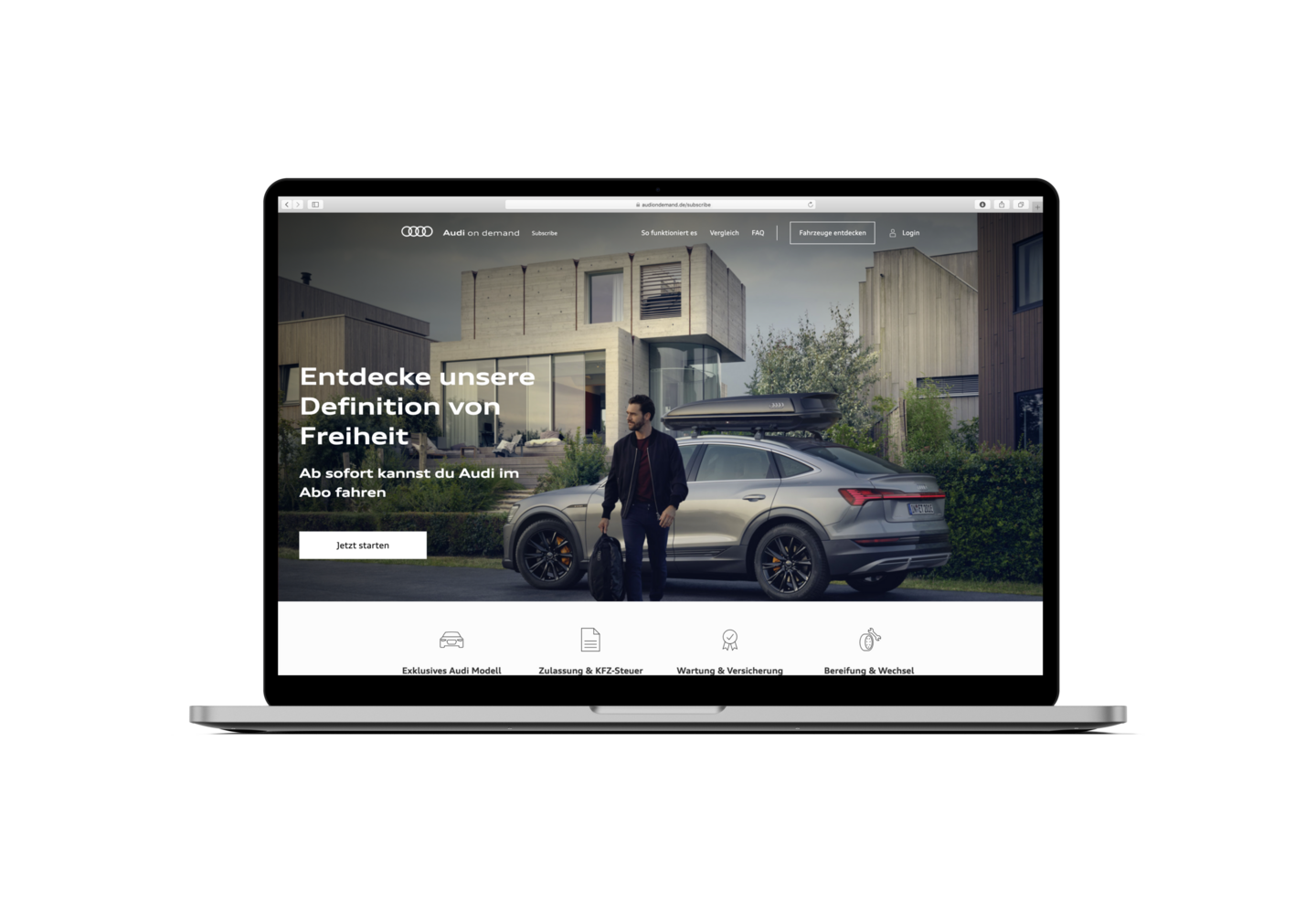
Audi on Demand launched at Munich Airport as a cohesive multi-channel service — app, web, and physical — under the positioning "Own the experience. Not the car."
App & Web Booking
Customers chose a specific Audi model, a duration (one-hour minimum, up to 28 days), and a pick-up or delivery location. Model choice led — brand logic, not rental-fleet logic.
Concierge Vehicle Delivery
An Audi concierge delivered the car and ran an in-person handover — vehicle orientation, preference setup, documentation. First contact with the brand was a person, not a parking lot.
Digital Key for Repeat Customers
Returning customers unlocked the vehicle via the app — no concierge needed for deliveries to private addresses — cutting cost for repeat bookings while preserving full onboarding for new users.
myAudi Sphere — Physical Hub
A branded space at Munich Airport to book in person, consult Audi experts, and see the fleet before choosing — bridging the digital service with an offline brand environment.
OUTCOMES & IMPACT
A pilot that became the blueprint for national scale
The Munich Airport pilot launched in December 2016 as the first Audi on Demand location in Germany. It wasn't just a successful launch — it became the proof point that unlocked the national rollout.
1
First Audi on Demand location in Germany — Munich Airport, December 2016 — across mobile app, web, and a physical hub.
2
Became the proof point for national expansion — the service grew to more than 65 dealer stations across Germany.
3
Audi publicly committed to launching Audi on Demand in 15 global markets by 2020, using the pilot model as the blueprint.
4
The premium rental concept achieved an NPS above 80 — against a car-rental industry average of 18–26.
5
The "Own the experience. Not the car." campaign built on the service won a German Design Award Special Mention and a Red Dot Design Award.
6
Demonstrated that a premium brand could operate as a mobility service provider — extending reach to customers who would never enter a showroom.
REFLECTION
What this project revealed
Audi on Demand was an early lesson in designing a service rather than a screen. The most consequential work happened before a single pixel — in the service blueprint, where operational logic, user expectations, and business constraints had to be reconciled at equal weight.
Orchestrating an external agency from an in-house position made clarity of specification a design skill in itself. Ambiguous requirements don't just slow delivery — they get built incorrectly and shipped under your name. Writing artefacts a vendor team could act on independently, then reviewing their output against the original intent, demanded a different rigour than pure interface design.
In hindsight, the service design held up better than the business model. The question was never whether users wanted premium on-demand access — they did — but whether a car manufacturer was the right entity to operate it at scale.